
A good handoff is not just a transfer from an AI agent to a person. It is the moment when responsibility changes hands. When an agent reaches a permission boundary, the customer should not have to start over, guess what happened or wonder who is accountable.
This article focuses on handoffs created by permission limits: a refund exceeds the agent’s authority, account ownership is uncertain, evidence conflicts or the customer asks for an exception. The examples are fictional and meant to help teams design their own workflows.
Name the Boundary Before the Handoff Happens
A handoff works better when the agent’s limit is known in advance. “Escalate when confused” is not enough. The plan should name specific triggers: refund above $75, return outside the standard window, failed identity check, conflicting order records, fraud flag, customer request for a policy exception or missing required evidence.
Those triggers should match the permission plan. If the worksheet says an agent may act only inside routine limits, the handoff should begin when the request leaves those limits. The agent should not keep negotiating, invent alternatives or execute part of the exception while waiting for a person.
OWASP’s material on LLM “Excessive Agency” warns that risks increase when an LLM-based system has too much functionality, permission or autonomy, and recommends limiting high-impact actions and requiring authorization for sensitive operations. A permission-boundary handoff is one practical way to limit autonomy when the stakes increase.
Preserve the Customer’s Request
The first job of the handoff is to preserve the customer’s request accurately. If the customer asks for a late return because the delivery arrived damaged, the employee should see that full context. If the customer has already provided an order number, photos, dates or a preferred outcome, the customer should not have to repeat everything.
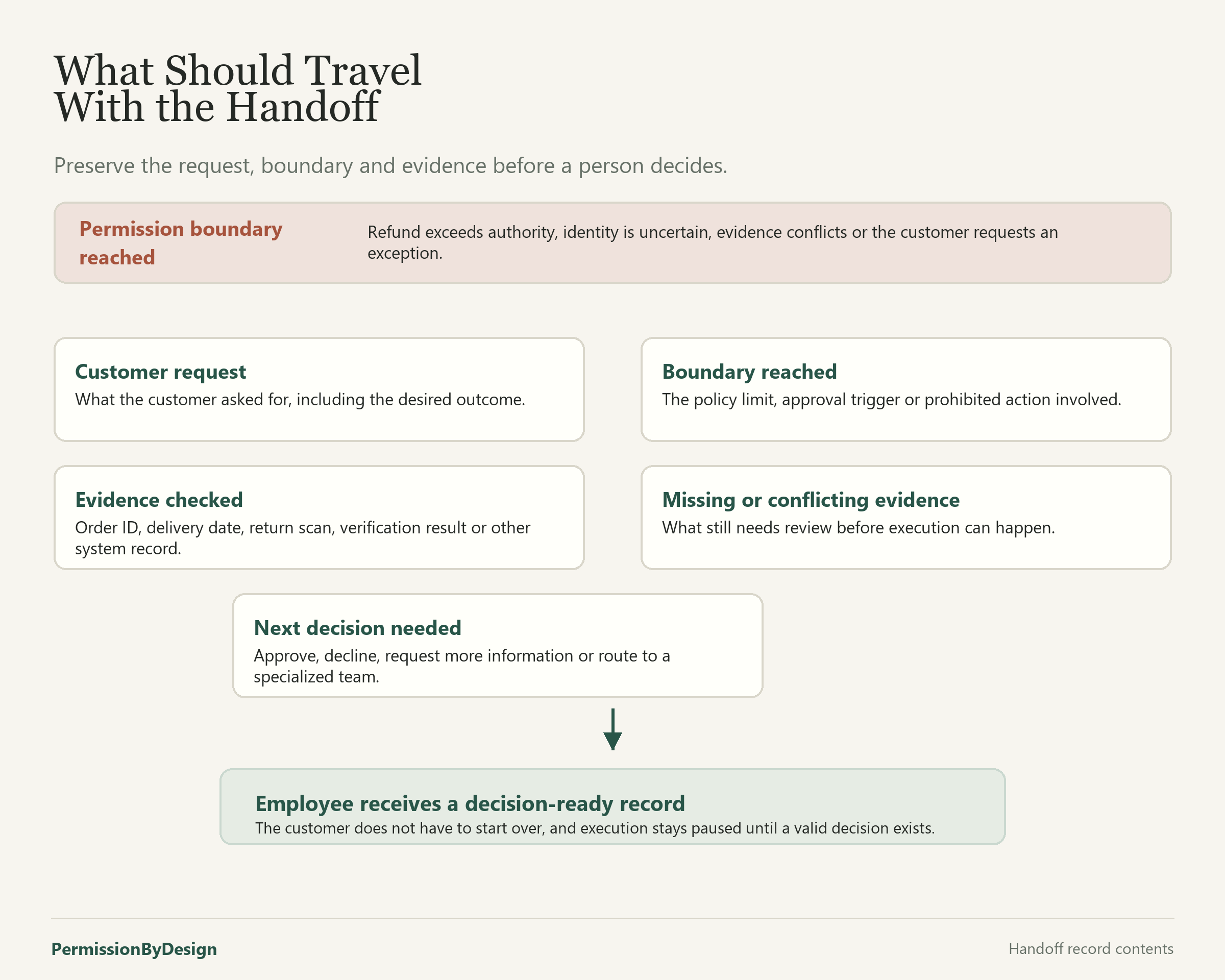
A useful handoff record includes the customer’s request, the action the agent was considering, the policy boundary involved, the evidence already checked, the missing or conflicting evidence and the next decision needed. In the Refunds and Returns example, that might include order ID, delivery date, return scan status, item condition, requested refund amount and the reason approval is required.
The agent’s summary should be treated as a starting point, not the only record. Important decisions should be supported by system evidence such as order records, verification results, uploaded documents, approval IDs and transaction logs.
Explain What Has Already Happened
Customers become frustrated when a handoff feels like a reset. The agent should clearly explain what it has already done and what it has not done. For example: “I checked your order and confirmed that the item was delivered 38 days ago. Because this is outside the standard return window, I cannot issue the refund myself. I’m sending the request for review.”
That explanation does two things. It reassures the customer that the agent made progress, and it avoids implying that the agent has already approved an exception. The customer knows the difference between an eligibility check, a recommendation and an approved action.
The same pattern works for account ownership questions. “I found the account, but the verification information does not match closely enough for me to change the email address. I’m routing this to our account team, and they may ask for additional verification.” The agent names the boundary without blaming the customer or pretending the change is routine.
Make Responsibility Clear While Approval Is Pending
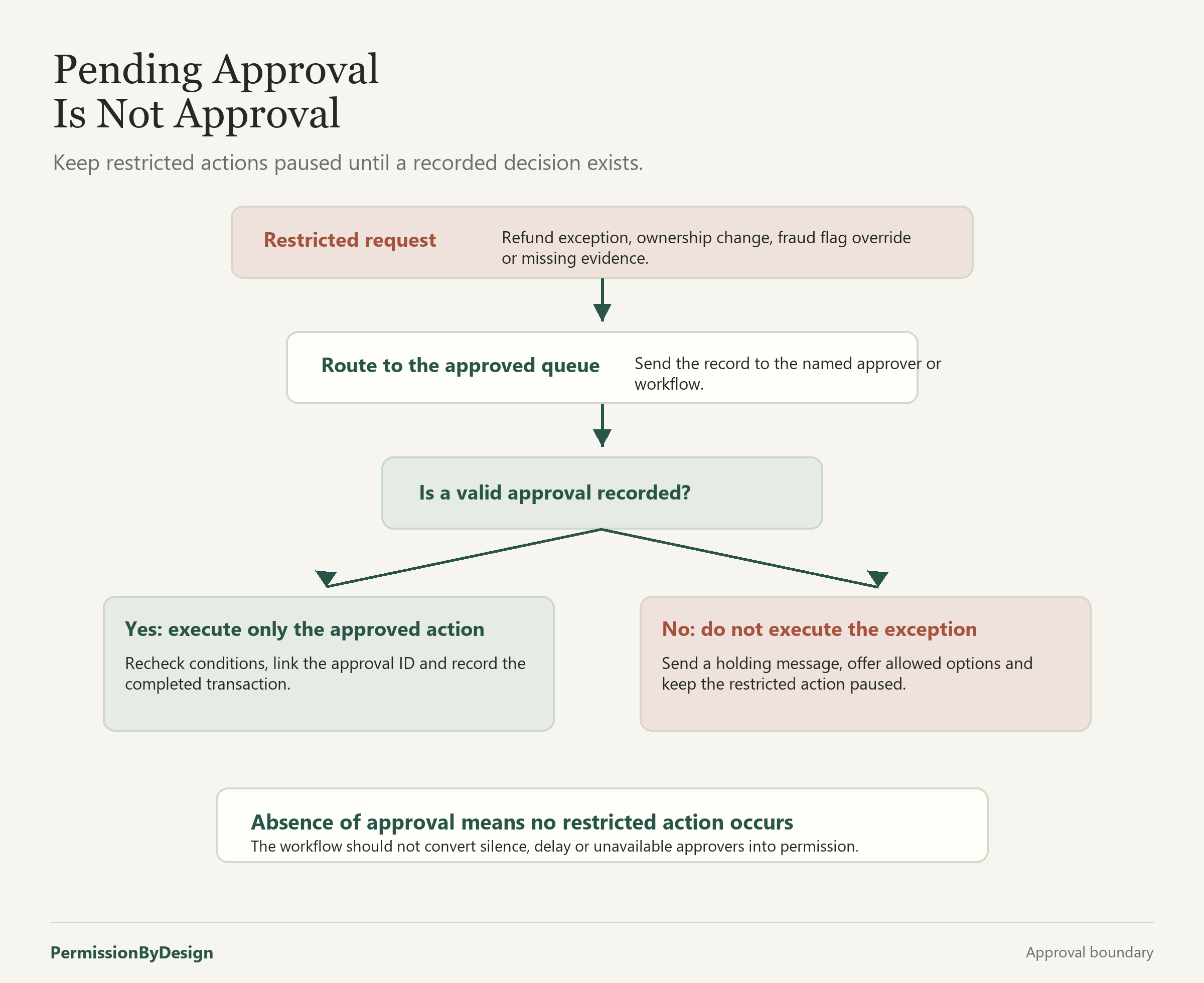
A pending approval is not an approval. The agent should not issue the refund, change the account or promise the exception while waiting. It may tell the customer what happens next, provide a reasonable timeframe if the business has one and offer allowed alternatives.
Responsibility should also be clear internally. Who owns the queue? Who can approve the exception? What happens if the approver is unavailable? In the fictional refund plan, a CX shift lead approves refunds from $75.01 to $250, and a support operations manager approves higher refunds or policy-window exceptions. If no approver is available, the agent may send a holding message and offer policy-compliant options, but it may not execute the exception.
This prevents a quiet failure mode: the agent reaches its limit, no person responds and the restricted action slowly becomes “allowed” because the customer is waiting. The permission plan should say that absence of approval means no restricted action occurs.
Design Different Handoffs for Different Limits
Not every handoff needs the same path. A refund exception might go to a shift lead. An account ownership dispute might go to a security or account recovery queue. A damaged-in-transit claim might go to a support operations manager. A suspected fraud issue might leave the agent workflow entirely.
Separate handoff paths reduce confusion. If every exception goes to a generic inbox, the approver may lack context or authority. If the agent chooses the path freely, it may route sensitive cases incorrectly. The plan should map approval triggers to approver roles or approved workflows.
The Account Changes and Purchases use cases show why this matters. A billing-contact update, payment action and delivery-address change may all look like “customer help,” but they create different business risks.
Keep the Customer Message Plain
The customer-facing handoff message should be direct and calm. It should not expose internal risk labels or make promises the approver has not accepted. Useful ingredients include: what was checked, what limit was reached, what will happen next, whether the customer needs to do anything and what options remain available now.
For a late return, the agent might say: “This return is outside our standard 30-day window, so I can’t approve the refund automatically. I’ve sent the order details and your request to a manager for review. While that review is pending, I can help you see the standard return options still available.”
For an uncertain account change, it might say: “I can’t complete this email change because the verification information does not match the account closely enough. I’m transferring the request to the account team so they can securely review it.”
Record the Handoff as Evidence
The handoff itself should leave a record. That record should show the requested action, the permission boundary, the evidence checked, the queue or approver selected, timestamps, decision, reason code and final customer message. If an approval is granted, the execution record should link to the approval record.
NIST’s AI Risk Management Framework emphasizes documenting system scope, internal controls and monitoring risks during operation. A handoff record helps make permission boundaries observable. It shows not only what the agent completed, but also what it declined to complete without review.
Closing Thought
A handoff is part of the permission design, not an afterthought. When the agent reaches its limit, the next step should be visible to the customer, useful to the employee and recorded by the system. Use the permission planning worksheet to define approval triggers, unavailable-approver rules and evidence requirements before the agent goes live.